Verona / Castelvecchio & the Scaliger Bridge
Museums · Architecture
Castelvecchio & the Scaliger Bridge
A fortified escape-route bridge and a museum renovation so influential architects still study it.
- Price
- From €6
- Hours
- Tue–Sun 10am–6pm, closed Mon
- Avg. visit
- 1.5–2 hours
- Book ahead
- Not usually needed
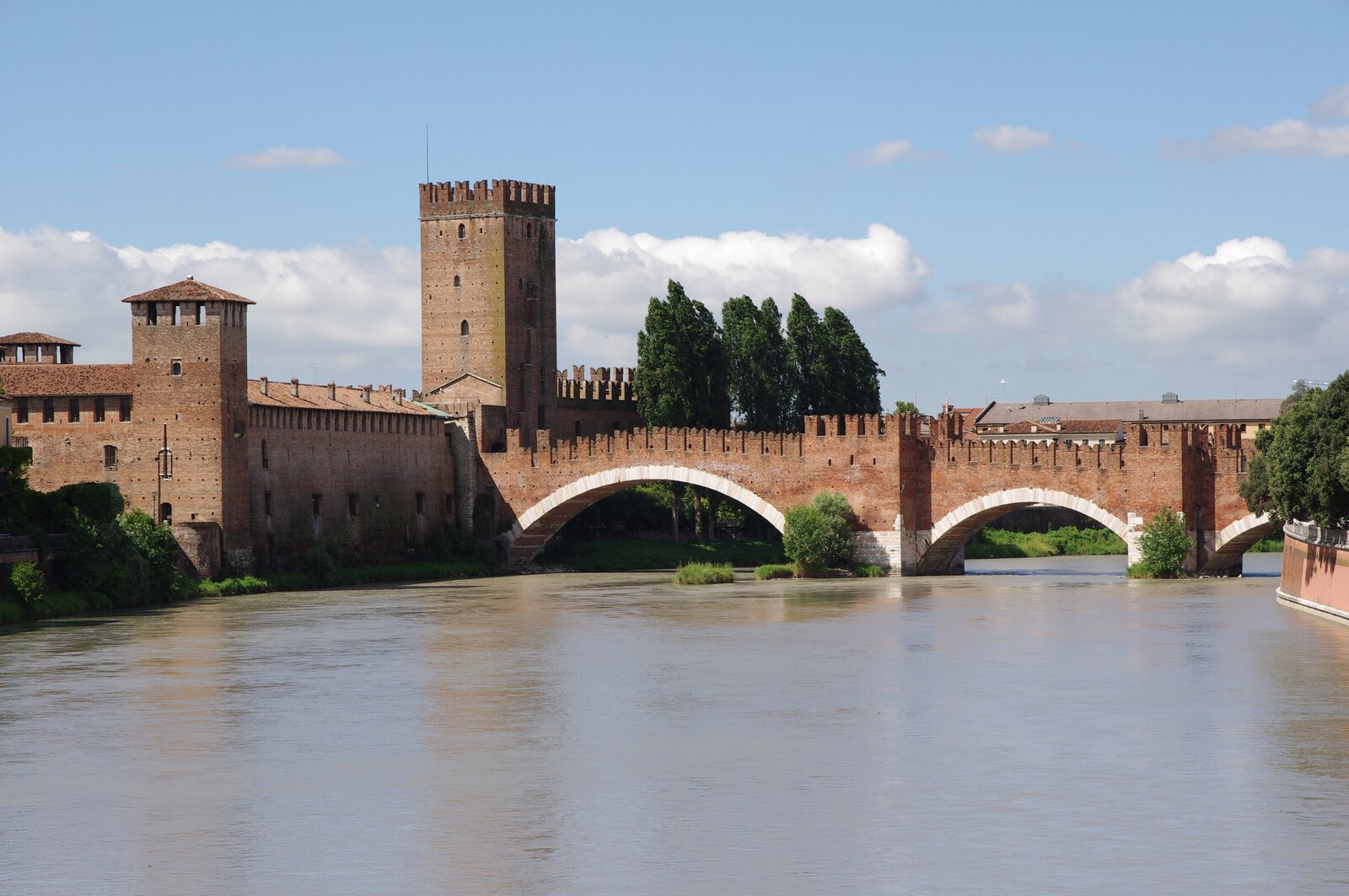
Cangrande II della Scala built Castelvecchio in 1354 as both residence and fortress, and crucially added a private fortified bridge across the Adige — a purpose-built escape route north out of the city, reflecting a ruler who trusted his own subjects only so far. The scale of that distrust turned out to be justified in the long run, as the della Scala dynasty's grip on Verona weakened within decades.
The castle now houses a museum famous well beyond Verona for a single renovation: Carlo Scarpa's 1960s intervention, which deliberately exposed the building's different historical layers rather than smoothing them into a false stylistic unity. The mounting of the Cangrande equestrian statue — suspended dramatically on its own plinth mid-corridor — is considered one of the defining moments of 20th-century museum design, still studied by architecture students internationally.
Inside
What to see
- Carlo Scarpa's celebrated 1960s renovation, deliberately exposing rather than concealing the building's different historical layers
- The Cangrande equestrian statue, mounted on its own dramatic plinth as the museum's central set piece
- The Scaliger Bridge itself, walkable across the Adige with views back to the castle
- The museum's paintings and sculpture collection, spanning medieval to early modern Veronese art
Practical
Good to know
- Both the castle and the bridge were rebuilt after being deliberately destroyed in 1945, using original stone recovered from the riverbed.
- The museum is genuinely significant for architecture, not just art history — Scarpa's renovation is taught as a case study internationally.
- The bridge is free to walk at any time, independent of museum opening hours.
Timing
When it's busiest
- Morning
- Quiet
- Midday
- Busy
- Afternoon
- Moderate
- Last hour
- Quiet
Nearby
Combine your visit
10-minute walk
Arena di Verona
Return to the Roman amphitheatre and Piazza Bra.
Visit →
15-minute walk
Basilica di San Zeno Maggiore
Continue west to one of northern Italy's finest Romanesque churches.
Visit →
Across the bridge
Roman Theatre & Castel San Pietro
Cross the river toward the ancient theatre and hilltop viewpoint.
Visit →
FAQ
Common questions
Why is Carlo Scarpa's renovation so famous?
Rather than restoring a false stylistic unity, Scarpa's 1960s intervention deliberately exposed the castle's different historical layers, becoming a landmark case study in museum design still taught internationally.
Are the castle and bridge original?
Both were rebuilt after deliberate destruction in 1945, using original stone recovered from the riverbed, so what stands today closely follows the historical structure.
Is the bridge free to walk?
Yes, the Scaliger Bridge is open and free to cross independent of museum hours.
How long should I plan for the museum?
About 1.5 to 2 hours for a thorough visit, including time to appreciate the building itself alongside the collection.