Genoa / The caruggi
Neighbourhood
The caruggi
One of the largest medieval centres in Europe by area, and genuinely disorienting to walk through.
- Price
- Free to walk
- Hours
- Always accessible
- Avg. visit
- Several hours, or as long as you want to wander
- Book ahead
- No
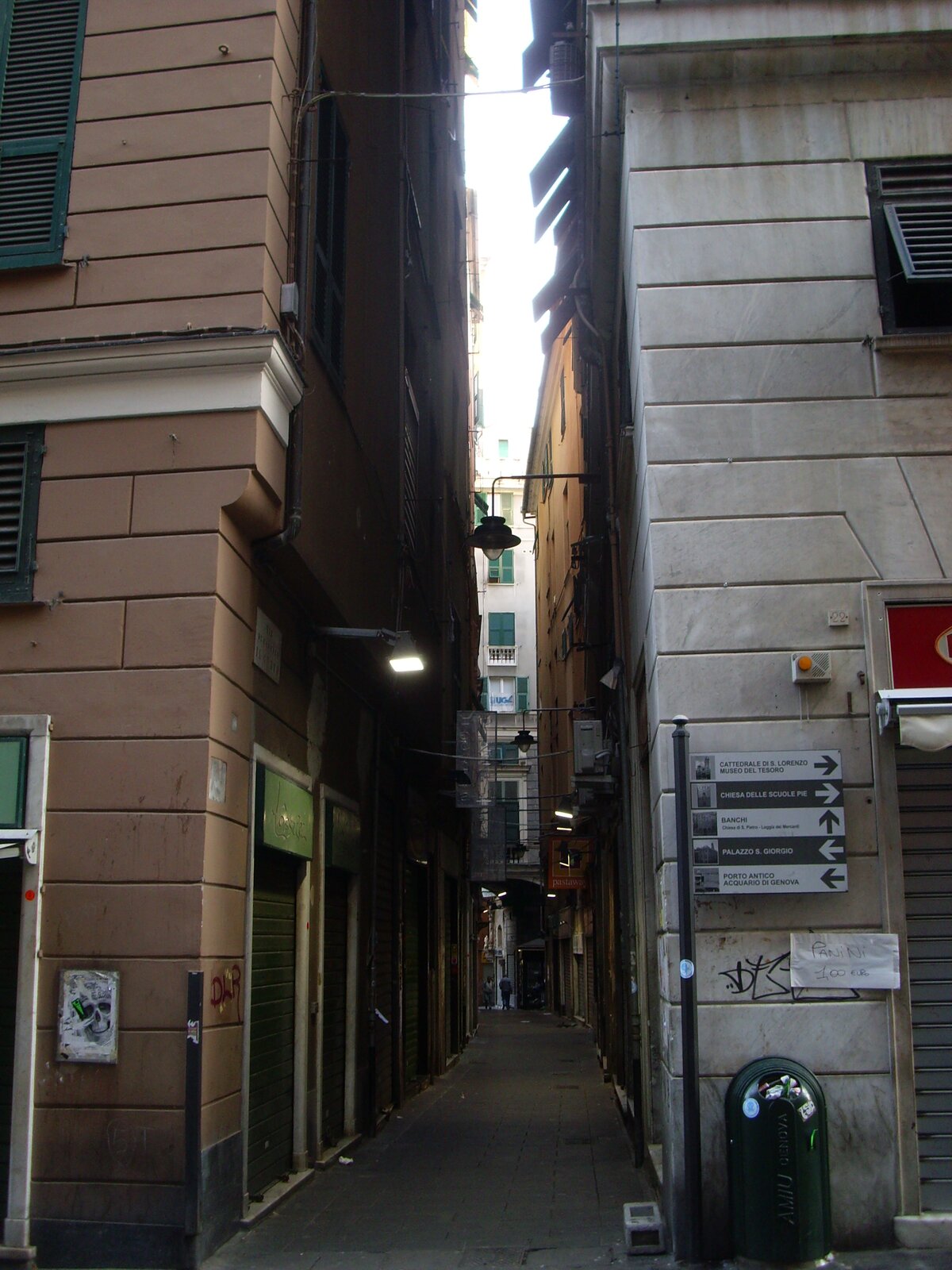
The caruggi — Genoese dialect for the narrow alleys of the old town — form one of the largest surviving medieval urban centres in Europe by sheer area, a dense grid of lanes behind the old port that largely escaped the wholesale demolition and rebuilding that reshaped many other Italian city centres in later centuries. Buildings here commonly rise five or six storeys directly above alleys barely wide enough for two people to pass, keeping many lanes in near-permanent shadow.
What makes the caruggi more than simply an atmospheric backdrop is continuity of use: some shops have traded in the same goods from the same premises for centuries, with confectioners, tripe sellers and drysalters still occupying storefronts dating to the 18th century. Small squares appear abruptly and without warning after long stretches of narrow lane, a layout that rewards wandering without a fixed plan far more than following a mapped route.
Etymology
Origins of the name and historic trades
The Genoese word caruggio (plural caruggi) denotes the narrow lanes typical of Genoa and other Ligurian towns. Treccani's dictionary derives the term from the old, popular Latin quadrŭvium, a variant of classical Latin quadrivium — a crossroads or point where four ways meet.
Many caruggi still carry names that point back to the trades once clustered along them. Via degli Orefici was home to goldsmiths, Vico degli Indoratori to gilders, and similar streets nearby — Vico del Ferro, Vico dei Lavatoi, Vico delle Pietre Preziose among them — echo ironworkers, launderers and jewellers in the same way. Genoa's official tourism office notes that the alleys' names almost always trace back to the workshops and guilds that once operated there. A related, less obvious layer of that guild history survives at street corners: many of the small votive shrines built into the old town's walls were commissioned by trade guilds, and beyond their religious purpose they doubled as a source of light for the lanes below after dark.
Inside
What to see
- Centuries-old shopfronts, including confectioners, tripe sellers and drysalters trading from 18th-century premises
- Small squares that appear suddenly after long stretches of narrow alley, often centred on an unmarked church or fountain
- The sheer verticality of the buildings, rising five or six storeys above alleys sometimes barely a metre and a half wide
- Directional signage pointing toward the cathedral, the port and other landmarks, useful given how easy it is to lose orientation
Practical
Good to know
- Perfectly walkable during the day, with a genuinely safe, lively atmosphere in most of the network.
- Some lanes near the waterfront are best avoided late at night — stick to the busier, better-lit routes after dark.
- Getting mildly lost is part of the experience — the layout rewards wandering rather than fighting to stay on a fixed route.
Timing
When it's busiest
- Morning
- Quiet
- Midday
- Moderate
- Afternoon
- Busy
- Night (waterfront lanes)
- Use caution
Nearby
Combine your visit
5-minute walk
Via Garibaldi & the Palazzi dei Rolli
Emerge from the alleys onto Genoa's grandest street of private palaces.
Visit →
Within the caruggi
Cattedrale di San Lorenzo
The striped cathedral sits within the same alley network.
Visit →
5-minute walk
Acquario di Genova & Porto Antico
Head to the redeveloped old harbour just beyond the alleys.
Visit →
FAQ
Common questions
Is it easy to get lost?
Yes, genuinely — that's part of the character of the caruggi, and it's worth embracing rather than fighting.
Is it safe to walk through?
Yes during the day, with ordinary city caution; some waterfront lanes are best avoided late at night.
How big is the network?
Large enough to be considered one of the biggest surviving medieval city centres in Europe by area.
What should I look out for?
Centuries-old shopfronts still trading in their original goods, and the small squares that appear abruptly after long narrow stretches.
Notes
Sources
- Treccani, "Carrùggio" — Vocabolario Treccani, on the term's Latin etymology
- Comune di Genova / Visitgenoa, "Secrets and surprises around Genoa" — on the alley names tied to historic trades