Florence / Attractions guide / Basilica di Santa Croce
Churches
Basilica di Santa Croce
The Franciscan church where Florence buried its own — sometimes called the Temple of the Italian Glories, and the largest Franciscan church in the world.
- Price
- €10 full price · €6 reduced (2026)
- Hours
- Mon–Sat 9:30am–5:30pm · Sun 1–5:30pm
- Avg. visit
- 1–1.5 hours
- Book ahead
- Not essential, but recommended in peak season
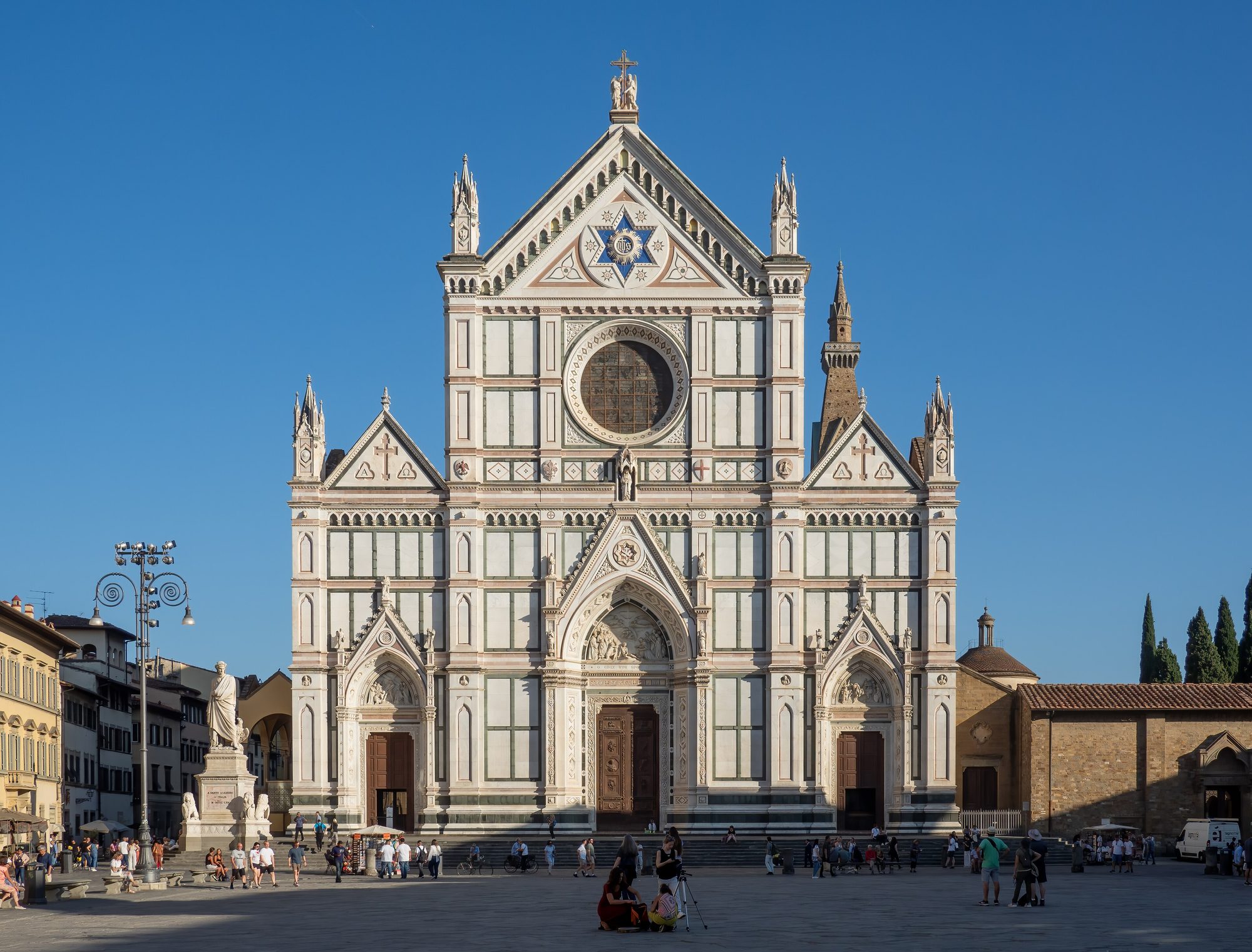
Santa Croce was rebuilt for the Franciscans from around 1294, likely to a design by Arnolfo di Cambio, on the site of an earlier chapel where Francis of Assisi himself is said to have preached during a visit to Florence. Its plain, unfinished-looking exterior for centuries gave little hint of what was inside; the marble facade seen today wasn't added until the 19th century, in the same neo-Gothic spirit as the Duomo's own frontage.
Inside lie roughly 300 tombs and monuments, including those of Michelangelo, Galileo, Machiavelli and Rossini — Dante has a cenotaph here too, though he is actually buried in Ravenna, where he died in exile. The Bardi and Peruzzi chapels hold Giotto fresco cycles from the 1320s that mark a genuine turning point in painting, the moment figures start to occupy real, weighted space rather than a flat gold background. Brunelleschi's Pazzi Chapel, tucked into the first cloister, is a small, perfectly proportioned piece of early Renaissance architecture easy to walk past without noticing.
Inside
What to see
- The tombs of Michelangelo, Galileo, Machiavelli and Rossini, and Dante's cenotaph
- Giotto's fresco cycles in the Bardi and Peruzzi chapels
- Brunelleschi's Pazzi Chapel in the first cloister
- The Museo dell'Opera di Santa Croce, included in the same ticket
Practical
Good to know
- One ticket covers the basilica, both cloisters, the Pazzi Chapel and the Opera museum — there's no extra charge to see any of these.
- The leather school at the back of the complex has operated since just after the Second World War and is free to walk through.
- Some fresco cycles may be partly obscured by restoration work.
Timing
When it's busiest
- Right at opening
- Quiet
- Late morning
- Busy
- Afternoon
- Moderate
- Last hour
- Quiet
Nearby
Combine your visit
10-minute walk
Duomo di Santa Maria del Fiore
West along Borgo dei Greci back to the cathedral complex.
Visit →
10-minute walk
Galleria degli Uffizi
A short walk toward the river through the old leather-working streets.
Visit →
20-minute walk
Piazzale Michelangelo
Cross Ponte alle Grazie and climb the hillside for the classic overlook.
Visit →
FAQ
Common questions
Is Dante actually buried here?
No — his monument in Santa Croce is a cenotaph, an empty memorial. Dante died in exile in Ravenna in 1321 and remains buried there; Florence has asked for his remains back more than once over the centuries, without success.
What's included in the ticket?
One admission covers the basilica itself, both cloisters, the Pazzi Chapel and the Museo dell'Opera di Santa Croce — there's no separate charge for any part of the complex.
Is the leather school worth visiting?
Yes, even briefly — it's free to walk through, run by artisans who train in traditional Florentine leatherworking, and it's tucked behind the complex in a way many visitors miss entirely.
How does it compare to the Duomo or Santa Maria Novella?
Santa Croce trades architectural spectacle for historical density — the payoff here is who's buried inside and the Giotto frescoes, rather than the building's exterior, which is comparatively plain until you're through the door.
Advertisement